Wednesday, May 21, 2014

Eating Together

(modified version of what I wrote for my church's newsletter)


A very happy time over dinner on my birthday in Nashville,
2009 with VT and JMU spring break group.
This year has been full of experiences that show how important a shared meal is, and I share some with you here.  Most of these thoughts are inspired from reading Eat with Joy by Rachel Marie Stone (InterVarsity Press, 2013).  I’d recommend that for further reading.  She is very good at connecting her experience with food with her faith in Christ.  She talks all about her eating disorders, dieting, feasting, and fasting and references the Bible at least every 2 pages. It’s very good.


Stone says on page 67,  “Our English word companion comes from the Latin for ‘with’ (com) and ‘bread’ (panis)—a companion is one with whom you eat your bread.”

My church's companion Rod moved away, but two of my fondest memories were at a meal with him; one at his house, one when he met me at True North.  How many of your stories with your pastor involve a meal?  How many of your stories with other people?  I only have one with Rod that didn’t involve food in some form.
Rod and I at an international dinner celebrating
his retirement.

My home church's former associate pastor Reverend Otis always talked about the importance of eating together.  I remember learning from him that the kingdom of heaven is that shared fellowship around a table.  The conversation and sharing that happens at a meal.  Maybe that's why we ate so much at church in Virginia. Our current associate, Bobby Spurgeon pointed out that most of the stories family and friends told about Gus at his memorial services were about food.  Gus stressing over baked beans in the crock pot at the dorm, Gus struggling to cook a bear arm in his college apartment, Gus eating weird combos of leftovers late at night at camp, Gus telling me we could eat acorns, Gus falling down while salsa dancing in his socks at Tony's house holding a slice of pizza, Gus' emergency salami supply in the bunkhouse, Gus and Peter at the Christian bookstore and Long John Silvers.  It goes on and on.   I would guess many of your memories of family and friends both living and past involve food.  We remember these times because we need food often, and when we share it we realize how much we need each other; how much we need God.
Marcus and Tessa's wedding dinner.  Lots of good times
(left to right) me, Gus, Joe, Jonathan, Tessa, Marcus, Megan, Kathleen, Sarah

Bobby also pulled in scripture of how people didn't recognize the risen Lord until he ate a meal with them. His own disciples couldn't see who God was until they ate together.  God reveals himself during shared meals and shares the meal with us. Most of Jesus’ conversations were at meals with people of various economic and social statuses.  Eating with the “unclean” is mostly what upset the Pharisees.

YAVs and Master Chief Ana getting local seafood
Eating together has a special healing power.  After my cousin Sarah’s recent death, her husband Mark and my other family have identified making family dinner with her kids as a priority.  We all know that’s important.  Eating dinner with their dad every night can bring them closer in this tragic, sad time.  In Eat with Joy by Rachel Marie Stone there is an entire chapter on the healing power of communal eating.  For anorexia, family-based-treatment or the intentional act of eating family meals and making patients eat their food with others has had success rates around 90%.  Communal eating has healing power!
Sarah's kids Brook and Grant enjoying a delicious meal together
at a family reunion, June 2013
In March, I volunteered at “Hearty Meals for All,” where volunteers cook a healthy community meal from scratch with as many local ingredients as possible at the Somerville Community Baptist Church.  They open it up to anyone who walks in the door.  They don’t check to see if you’re homeless before you get food, or if you “deserve” it.  Anyone can come and dine together.  Eating there, I conversed with some volunteers and a homeless guy named Eliot, but there was something powerful about the table that put us all at the same level.  It was just as awkward to talk with the homeless man I didn’t know as the other volunteers I didn’t know.  We could all share something intimate trying to talk with a mouth full of food, and talking about the weather.  The same thing happens every day at the Women’s Lunch Place downtown on Newbury Street where another YAV, Audrey works.  No need to distinguish class, race, just come and get food if you need it, if you want it, if you’re hungry.  And when you sit at a table with other people you are all the same vulnerable people who depend on this earth and food and God for sustenance, nourishment, and survival.  We all share equally in that place of feeding and conversation.

Jesus’ table is open to us a lot like that, but better.  We are all invited.  We are all sinners.  We don’t have to show proof of income, check the box with race, and check if we’ve been convicted of a felony or misdemeanor.  He knows us, takes us as we are, feeds us and makes us whole; makes us who he created us to be.  We can remember our welcome place at God’s table when we eat with others, and we can get closer to them and to God when we break the bread. 

Justin, Gray, and I at Dairy Queen in College
Because it’s so important I have a challenge for you.  For the rest of this week or this month have more meals with other people than meals alone. Invite someone from your job or church out for coffee or for lunch.  Take a meal to a shut in and eat with them; or even to a neighbor who isn’t shut in.  Sit down with everyone in your family for dinner around a table.  We know it’s important. Let’s eat bread with our companions in Christ. We may even recognize him among us like the disciples.

Food Corps volunteer and former JMU classmate
Nick Joins the YAVs in Chinatown
For more on food and faith check out the Presbyterian Hunger Program website blog where the YAVs post regularly (http://www.pcusa.org/blogs/foodfaith/) , the YAV program website (www.bostonfoodjusticeyavprogram.wordpress.org) , or just ask me, Alex, to get a meal with you and we can talk about food and faith. I’ll even help you cook it!

Monday, May 12, 2014

Let it go

Many of you have had me and the families of the recently and too soon departed Gus Deeds and Sarah Johnston Defren in your prayers.  Thank you and keep praying for healing and coping for all of us, but for the most part we are surviving and doing ok.  It just sucks.  I want to just tell how wild the week has been.

On May 3, friends and family from Bath County gathered at the Millboro Elementary School for a memorial service for the dearly beloved Gus Deeds.  More friends of his gathered at Nature Camp that afternoon.  The newspaper has ALL the details here.

It was good.  I cried when they played James Taylor.  One time Gus got so mad I was playing Kansas in the car.  He just couldn't handle it, too depressing.  So he put in James Taylor (which somehow was less depressing).  Fire and Rain, "I always thought that I'd see you again"  Thanks a lot for keeping depression to a minimum Gus.

Anyway it was a day to celebrate his life, and we did.  We all told Gus stories which either involved shenanigans, music, dancing, his baked beans, or all of the above.  I got to chat late into the night (pretty deeply) with some of his past roomates friends, and a girlfriend who shared something special with Gus.  The parts of his life I didn't know about weren't as bad as I'd constructed them in my head.  We are all better people after knowing Gus.

After a delicious breakfast at camp, a bird walk, and a too-long goodbye that made me late for church in my watershoes, I met up with my family.  We were on our way to see my brother, Isaac in a play.  My Aunt Susan and Uncle Keith were going to come down to see us there too. 

On the way to the play they called to say they weren't coming.  Their niece, my cousin Sarah had collapsed from a heart attack at the finish line of her half marathon in Frederick, MA and they were babysitting her kids as her parents and husband went to see her in the hospital.

....[insert bad words]

She never really woke up.  Stayed in a coma-like state until she died on Tuesday the 6th.  Gus' birthday.  (makes for a good country song).  This article tells the story pretty well.  Some friends are raising money for her kids online here.

It hit all of us in the family differently.  For me it was wake up call that, as much as I want it to be, life isn't just about Gus.  Another reminder life is short.  Too short. God's timing isn't ours.  I was very thankful to be at home with my family hearing it.  Thankful she didn't suffer long.  Thankful she crossed the finish line with a smile on her face, she finished the race, even though she left us with tears on our face, to go live in Grace.

Weird how that stuff works out.  She didn't die on a back road in Shenandoah County, my sister saw the bright side.  She collapsed after finishing the race where the medics were with the machine to revive her.  Enough time that she may have heard her husbands voice, her parent's voices, her siblings, nieces and nephew's voices, and her kid's voices in the hospital before she was gone forever, and they saw her "alive."  Enough time for her daughter Brooke to sing her a song "Let it Go" from Disney's Frozen.  But not as much time as we'd like.  I am sad thinking of Mark and the kids, and the Johnstons going on without her.  But they still have each other and her love.


On my way back to Boston, my bus drove past John Hopkins hospital where she died.  I wasn't ready to see that.

I learned from all the Sarah stories that in her early days of running, her friend and running partner Matthew had a mountain climbing accident that left him paraplegic and unable to run.  Sarah said she'd run for Matthew because he can't any more and she'd always run if it killed her.  She finished the race.

2 Timothy 4:6-8:  the time of my departure has come.  I have fought the good fight, I have finished the race, I have kept the faith.  Henceforth there is laid up for me the crown of righteousness, with the lord, the righteous judge, will award to me on that Day and not only to me but also to all who have loved his appearing.

One of the oldest of my 12 cousins, Sarah was 14 years older than me, and she always scared me a little.  She was mean in the sense that she told you how she felt, and growing up I never much cared for that.  She never fussed to make a fuss, just to let you know you were wrong when she was right. She was usually right.  I specifically remember one Christmas when she handed my two brothers and I each a present wrapped in the same size box. I guessed it was a shirt because I recognized the shirt size gift box.  I didn't want any shirts at the time, so I sat it aside ungratefully.  I didn't even say thank you, and promptly got back to my more important pokemon game boy game.  An argument with Sarah ensued about how ungrateful and spoiled we were that left me in tears--but she was right, I was being an annoying little brat.  She made me open it in front of everyone, and boy was I wrong about the shirt, it was a snickers bar!  She wrapped the snickers bar in  a t-shirt box!  Taught me a lesson.

Sarah wouldn't take nothin' off any one of us cousins, or anyone really.  She'd respectfully, (sometimes grumbly) listen to her parents (sometimes) and my mother (sometimes).  She was always strong willed and independent, and intimidating to me.  But she was never hateful in that intimidating, just the voice of truth (and the truth is what was scary I think).

Once I started running cross country I noticed her words to me were less abrasive.  But that was about the time I shaped up and quit being such a baby.  Her last words to me in January were about all the pictures of me in Boston with my long hair and all the lady YAVs.  She never messed around in what she wanted to say.  But she was full of love.  This is the last thing I heard from her in January:

" Hey Alex. If your facebook pictures are any indication of your future, I would think you were in training to become a fundamentalist Mormon, preparing for polygamy :) Hope you're having fun and staying warm! A house full of girls is a big change from a house full of Haneys. Good luck!"
My cousins, Elizabeth and Sarah at the family reunion June 2013


I heard her sassy undertones in all of her stories this week and I see it lives on in my cousin Kristi who is about her age.

Sarah, you inspired me to me start running again.  I never got to have a good conversation with you and Mark about how silly they talk up here in his hometown of Boston.  I know we all wanted to.  You left many others even closer to you missing things they wanted.  But I know that you know after your argument with God about how soon you left your family that He's got it covered and it's going to be ok. Give Gus a big hug for me up there will you, he was high school valedictorian just like you.

And St. Peter, when Sarah tells you not to let her Uncle John and the Haney's in, she's just kidding.

"Let not your hearts be troubled" from John 14 we heard at the funeral.  How true it is.  All the pain and loss does not compare to the glory about to be revealed to us.  God is working, he's building up his team of angels up there and doing far more than we can ask or think.  In hope we await the revealing of what is to come. And because of that hope we don't need to fear.  But it still hurts.

We don't know how short our time with our loved ones will be, so take care of that stuff that's bothering you with them.  Likewise, friends, sisters-in-law, colleagues all disappear as soon as they come, don't hold things against them.  Let it Go like the song.  Start with forgiveness and put up with their annoying political opinions for the sake of having known them as much as you want when it's all over.

Life is short, start running.
Sarah (front left in pink) finished her race on Sunday

Monday, May 5, 2014

Meet the animals that become your meat.

Our Daily Bread is an unscripted film that just videotapes typical daily scenes on the large scale agricultural operations that bring us most of our food.

If you watch it you will see workers picking fruits and vegetables, driving machinery, and eating.  Chicks riding conveyor belts, being thrown into bins, having their beaks clipped, scenes of life in the chicken house, and even the harvesting and cleaning details.  From the first seedlings to the final harvest, and from the calf, piglet, and chick all the way through the slaugher you see in short segments just how it happens.  It's simple, without commentary telling you if it's bad or good, just what it is. Granted it appears more biased toward, "it's bad"

Two things I gleaned from it were
1.  Not everything in industrial agriculture is innately bad, but it easily can be when the goal is ONLY profit, and
2.  maybe people in the agricultural system are just as mechanized as the animals.

1.  In my line of work, some colleagues, and I throw around terms like "industrial agriculture" and "factory farms" like they are completely terrible, but maybe not. I think we'd all have a hard time convincing a grain farmer not to plant the rows of monoculture year after year with the gas-guzzling machinery, or persuade a meat producer he's killing and cleaning his meat wrong because it's done by machine.  Were I to kill, clean, and slaughter every cow without the machine to pick them up and move them around dangling by their feet, I'd think twice about eating meat.  Were I  or anyone else to go out and scythe, rake and pile wheat by hand, then separate the wheat grains from the rest of the plant I may think differently about monoculture and machine harvesting. I spent a day bailing hay at a neighbor's farm a few years ago with my friend Gus.  Even with the tractor to cut, rake, and bale it for us, it was still the hardest day of work in my life.  Farming is work and technology can make it easier and more efficient.  That's why we make it. Maybe the productivity of a combine does help the world?  

However, most agricultural technologies ease the work of farmers, but the question is where do we draw the line?  What ag. technologies and practices make food easier and better for the consumer, for the environment, the animals?  Does the massive yield and lower price make things better for the customer?  With the obesity epidemic, and type 2 diabetes on the rise, I don't think so.  Even if the cheaper hamburger or corn syrup frees up some pocket change, you could pay for it in hospital bills when you're older.

I argue the problem with our food system is that the idolatry of money has focused the emphasis on technology on maximizing yields thus maximizing profits, yet this serves the wrong master. We need to and are slowly adding other values to the mix besides profit.  Perhaps good health, lower hospital bills, clean air, equal access to healthy food should all be worth attaining with food.  Don't stop with money.  Make the end result something valuable beyond dollars. It's not the industrial agriculture that's wrong, it's the way industrial agriculture only worries about money.

2.  The film also showed some scenes of farm workers eating alone, or driving a tractor, fig-tree-shaker, or other machine.  I wondered if they were drawing parallels between the farmers crammed into the box of a tractor doing a tedious job to the cows and pigs trapped in cages in side where it's crowded.  Neither one looked particularly excited to be there...

This is a little on how the film affected my day.  

Before we watched the film we had our "Salad Dressing Throwdown" where Maggie had us split into two teams and make our own three salad dressings from scratch.  And we ate a ton of salad.  Read about that here (Kathleen's post,)

After the film we went to Tavern in the Square for Libby's Birthday.  It's a restaurant with DELICIOUS Mac&Cheese.  Good enough to hit the person next to you.  Since we ate salad for lunch, I went crazy and ordered meat for dinner.  Come to think of it it was the first time I had beef since Ana and my parents visited in January! Woah.  Meat has become a special treat here.  On the local food diet, meat is expensive, or rather it is the price of something that gives the farm hands a fair wage and the animal a good life.  Plus it's not fed cheap excess subsidized corn, or grown up packed into a tight feedlot or poutlry house to maximize the yield and productivity of a space while damaging everything but the profit margin.  Our chicken CSA has been our main meat supply and it gives us enough for about a full chicken once a week.  That's a little less meat than a person in 'Merica eats I think.  But when you see (and actually pay for) the environmental and health costs it's worth it you won't mind that extra 50cents a pound.  Consider this:  All four of us on the local Massachusetts food diet did not get sick one day this winter (more than a brief stuffy nose)--None of us have ever spent winter in New England, and none of us got flu shots!

Since it was Libby's birthday, I ordered "Meatloaf Cupcakes"  They cut meatloaf in cupcake shapes and wrap it in bacon, and "ice" it with mashed potatoes and onion rings.  It looked like cupcakes, and reminded me of the "Bacon-wrapped Bambi" at a friend Jeff's house as he called it, which was way better than the meatloaf at the restaurant.  that's more like 'Merica!  (Bacon-wrapped Bambi was locally sourced venisin steak with bacon and cost a pretty penny).

It wasn't until about halfway through my second meatloaf cupcake when I remembered the artificially inseminated cows in the film, the castrated piglets from the film, and the mother pigs squeezed into cages so they don't roll over on top of the piglets nursing them for milk.  I was eating both of them the pig and the cow in my meatloaf cupcakes.  the old quote from Becca Deeds on the Baja trip, "how many animals are you eating today?" came to mind.  They tasted so good, but gave me the feeling that I was just perpetuating the system of the good bad and ugly from the film.  The restaurant claims to serve only grass-fed and free-range meats, but how much of  America's meat fits that category?

I used to say you know the true cost of heating your house in winter when you split, haul, burn, and clean the ashes from the wood yourself.  So maybe if every one of us were to raise, feed, slaughter, and prepare a cow instead of just have it wrapped up for us hidden between ketchup and bread at the drive thru, or wrapped beautifully in bacon on a fancy plate, we may understand the true cost of eating meat. A year ago at NuBeginning farm in Virginia I harvested quail.  I "did the deed" on 4 of them, watched them twitch, de-feathered, cleaned and packaged em up.  The whole bit.  It was a powerful time.  It felt like the movie Avatar, when he tells the animal "I see you and I thank you."  Audrey and Kathleen did this with chickens in the fall up here (Click here to read their stories:  Kathleen's and Audrey's)

 Some of my neighbors at home made their kids go to see a slaughter at least once in their life so they knew what has to happen for us to eat--something has to die so that we might live.  Life is given and sustained through sacrifice.  (hint: Jesus)

I'm not a dirty hippie, vegan, or vegitarian--entirely.  I'm a Food Justice YAV.  I still like a good burger, love me some bacon, some chicken fried chicken, and shrimp 'n grits, but I'm seeing now that it's worth paying for the quality, limiting my meat intake, and knowing where it comes from.  And beets and radishes aren't all that bad.  Lets face it there are 7 billion human mouths to feed and we're feeding all this grain and food to animals so we can have cheap meat at every meal.  Where is justice there?  So many people in the world don't get dinner on Libby's birthday, and I'm eating a cow wrapped in bacon shaped like a cupcake, and both of those animals ate enough to feed those hungry people for a long time.  Where is justice on my plate?  When we really see what's going on, it's clear that we have a lot of fixing to do.  Our Daily Bread shows us a little of what's really going on.  So stand with me and eat less meat and learn where your meat comes from.  See your food animals.  Know them and thank them for dying for you, like Avatar.

I challenge you to start going one day a week without meat--OR if you think that's easy, only eat meat once per week.  Can you out-do me and become vegetarian? How little meat do you eat?  What's holding you back? Leave a comment


Wednesday, April 30, 2014

The "Dirt" on the Church's Dirt


--I wrote this for my church's newsletter and thought I'd share it with you at home and in internet land.  Please note it we still have not reached the "last frost date" yet in Massachusetts--


The “Dirt” on the Church’s Dirt

Church member Kim rakes the newly tilled soil 
After preparing a garden bed here at the church and our community garden plot in Watertown, I’d like to share some insights on dirt, dust and soil from Lent. I also learned some theology in Soil and Sacrament by Fred Bahnsen, which really highlighted how we are connected to the Earth. Soil is the basis for all life. It provides a medium for plant growth for our food. Even the stones and wood in our houses, and really everything we own comes from the Earth. If we ever needed a reason to take care of it: all we have is made from it. I’d recommend the book to anyone curious about food or faith or soil.

Our connection with soil, the Earth and food starts at the very beginning when God created Adam-[Hebrew for “Red”] from the Adamah “red soil” and the very first thing he tells Adam is to “Till the earth and keep it” On page 8 Bahnsen puts it:

"The garden is our oldest metaphor. In Genesis God creates the first Adam from the Adamah, and tells him to “till and keep” it, the fertile soil on which all life depends. Human from humus. That’s our first etymological clue as to the inextricable bond we share with the soil. Our ecological problems are a result of having forgotten who we are—soil people, inspired by the breath of God. “Earth’s hallowed mould,” as Milton referred to Adam in Paradise Lost. Or in Saint Augustine’s phrase, terra animata—animated earth.  The command to care for soil is our first divinely appointed vocation, yet in our zeal to produce cheap, abundant food we have shunned it; we have tilled the adamah but we have not kept it."

I used to think the Lenten image of coming from dust and dirt was depressing, “all we are is dust in the wind.” But when you think about it, beautiful mountains are made of the same dust as us. Volcanoes,
birds, venus fly-traps—all from dust. We YAVs often remember shooting stars are made from the same dust! We are dirty and mortal, but for some reason, we are the dust filled with the breath of life, the
breath of God.

I felt it timely to read this while planning to build some raised beds in front of the church. The original garden plan was to build raised beds and add all new soil. But when we realized our wood was pressure treated with “cronized copper azole” which the internet says may contaminate the soil and make edible plants toxic. We looked for alternatives.

In a conversation with the expert, Farmer Dave Dumaresq, the idea came up to just test the soil in the yard for about $20 and add whatever nutrients were needed for probably another $20. After all, almost any farmer will tell you, “soil is your most important crop”. After looking further into costs it would be around $100 to buy wood and entirely new soil so we decided to work with the existing soil to save money. April 5 during the church work day, I mailed in a soil sample to UMass Amherst Extension. Look for the results on a bulletin board soon. Basically the lead levels were safe, so we could plant edibles, but it hadn’t been tilled or kept in years. It was very deficient in the macronutrients; particularly phosphorus, also lacking nitrogen, potassium, calcium, magnesium, and manganese.

UMass and Farmer Dave gave recommendations on what to add, so I spent $15.09 to add dolomitic lime to raise the pH and some fertilizer to add the nutrients. I chose a chicken-manure based fertilizer because of the high phosphorus content. Chickens are fed more phosphorus than they need, so their poop is very high in phosphorus and in large chicken houses, the phosphorus is so concentrated it can cause problems in the water table as it leaches into the soil. So sourcing manure for phosphorus on our yard, is helping to reduce the strain on the groundwater below a chicken house somewhere—but it doesn’t solve all the problems. And it gets back to the “to dust things return” idea.


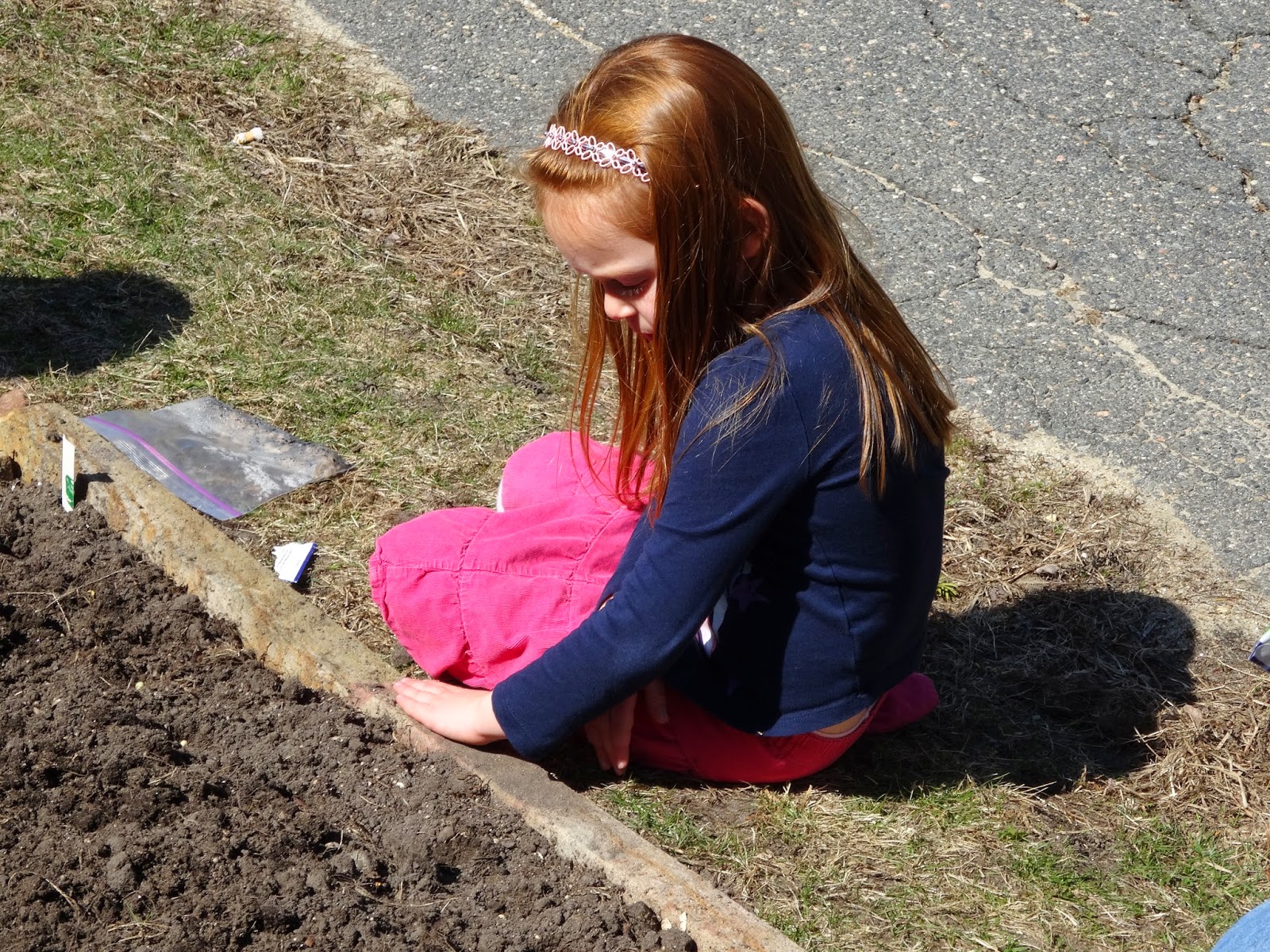
In just 2 hours with 4 people, a few tools, and $35 spent on a soil test and amendments we prepared the garden bed on Monday the 14th, and the Manna Monday kids planted seeds and bulbs in it on the 21st.


 Watching Sally, Arielle, and Kim help me dig up the soil, the kids dropping in seeds, and 6-yr old Adelchi Grassini hi-five me with dirty hands on Manna Monday, I felt we were honoring God’s first vocation to Adam, to “Till the Earth and keep it.”

Take a look at the garden when you get the chance. If the rabbits don’t eat everything, we may have some fresh veggies and herbs from our little piece of Earth, Adamah, for coffee hours this year.


Thursday, April 24, 2014

The Easter Encounters #1 Black and Pink Guy

In leu of the 12 days of Easter I decided to focus on all the people I've met here and the mysterious ways God is working in my adventures, beyond my control and in ways I wouldn't.  On the first Easter people saw the real face of Christ in some people they randomly bumped into.  I want to write about specific people I've seen in Boston this time of Easter who are the hands and feet of Christ, and I see it in their faces.  Also a few side notes on other cool missionary stuff in Boston might show up here.

#1 Black and Pink Guy

We usually eat dinner together, but Audrey and Libby had services to attend at their churches, and Kathleen was going to meet Libby at Harvard square to go with her.  Harvard is where the bus takes us from our house to get on "the T" (or subway, like "the metro" in DC).  I planed to go on my own to the University Lutheran Church in Harvard, near the Harvard Campus.  They were finishing a Thursday night series of meals that involved serving communion at a table in the sanctuary as part of a potluck dinner.  Two weeks prior I did it and we literally passed the bread and juice to each other around the table, and then the soup and salad, and wheat berry dish from Whole Foods, and glazed carrots, and chipotle nachos with lime, and then read the bible and ate cookies all at the same time.  Our Lord's last supper for supper. None of this one little piece and a shot stuff we do on Sunday worship.  God gave ALL of himself to for our sins, for ALL of us, to fill in our gaps and shortcomings, eat and be filled!!

So I was walking to this church when I walked past a particular guy on the bench.  He looked familiar.  I recognized him behind his glasses, but wasn't sure because his hood was all the way up, he looked at me too.  When our eyes crossed we did the awkward quick look away as if nothing happened.  But then I recognized his backpack and a white reusable shopping bag.  I continued the awkward walk-away from the awkward look-away.  Then I stopped.  It hit me.  On Monday doing the Farmer Dave's distribution, I had a conversation with this guy, close to my age.  He comes into the church every so often to pick up food for Lisa ______ when she's out of town.  This week he was packing it all into his red backpack and white shopping bag because he biked to the church.  I remember talking to him about how crazy that road is for bikers.  There are so many potholes and you often have to choose between hitting the pothole or hitting a car to dodge it, and if the bus ever comes by while you're biking there on rt. 3A, well all the angels this side of the book of Revelation better come to protect you or get ready to carry you on to heaven.  I couldn't imagine biking there with the week's food bungee-d to your back like him.

I was at the end of the sidewalk when I did the creepy turn around to see if he was still there because I knew who he was now, and the internal battle played in my head; "do I say something to him or not."  So I just did it. I walked back and asked, "do you pick up food in Burlington for Lisa ______?"  He said yeah, and that he recognized me too.  Funny how that works--ask that person the next time YOU see them on the bench.

I got his name, he lives in Burlington.  He used to live in Allston across the river from me in Watertown.  He stopped in Harvard on his way to Dorchester (a less affluent neighborhood on the south end of the red line train) for a meeting with a group called Black and Pink that advocates for incarcerated LGBTQ ABCDEFG people.  They send newsletters, and coordinate pen pals with inmates as a ministry.  He told me all about it.  I could see his passion for the issue, he was almost as weird about it as I get with food sometimes meeting new people.  He just kept throwing information at me because I know so very little about these nuances in our prison system.  I was super encouraged to see this kid, probably younger than me, doing incredibly powerful work for so many people.  We crossed paths pretty out of the way for our usual places, and he inspired me.  Maybe I inspired him?

Just a side note about prisons, a few weeks back I saw a documentary with Libby called "The House I Live in" about the prison system and the war on drugs.  Check it out.  That one hit home since at home half my neighbors in Virginia work at the prison in Craigsville, and the other half got busted for cooking crystal meth (slight exaggeration).  I know maybe 20 families that work there and maybe 4 arrested for drugs.  Libby cares much more about the criminal justice system than I did until recently, and she's shown me a lot of Bread for the World's resources on incarceration (check out this one about Nate's story).  Particularly how hard it is to get a job after finishing time in jail.  Haley House where I volunteered the day after Christmas(see 2nd day of Christmas post) has a cafe set up by the Catholic Workers to train and employ ex-convicts in a restaurant.  It helps the economy, people, and local farms where they buy the ingredients.  Plus it's the only place up here I've found that serves cheese grits!

We spend so much tax money taking care of people who've messed up, or maybe have just been victims of our broken system.  Why not invest that money into social work programs like Haley House, or Thistle Farms in Nashville, or Dismas House, or many other programs popping up that let them contribute to fixing the system that perpetuates crime and violence.

After the guy on the bench and I parted ways, --him to work for the kingdom, and I to worship in the kingdom--I decided to no longer go to the Lutheran church, but to meet Kathleen and Libby there at Harvard to go to Libby's church with them.  I met them at the B.Good burger place and bought some dinner--A veggie burger with bacon (and got some funny looks).

The service was very reflective with lots of Taize music.  It's music and scripture that repeats simple verses over and over  and over and over just beyond the point where you get tired of the same words, but you move into actually thinking about what the words mean and what God's saying to you in them about the 19th time.  The service ended peacefully after more contemplative music, verses of Jesus' final hours, and sharing communion (not with soup and cookies, but in the pews with the little shot glasses and identically cut squares of potato bread).  God broke his body and poured out his blood for us.  Maybe we don't need that other stuff, the soup, salad, and wheat berry dish from Whole Foods.  God gives us enough, and he asks us to give it to others.  What a special opportunity to have.  This guy on the bench shared his blessings with others in Dorchester on Maundy Thursday.


Tuesday, April 8, 2014

All the men in my life are gone


All the men in my life are gone.  That’s not really true at all, but the two I see regularly are leaving. 

Ryan Scott McDonnell
Ryan's Facebook picture
Twice a week every week since I got here (except holidays and retreats) I’ve spent the day with Ryan McDonnell with the Boston Faith & Justice Network.  He’s a super tall, highly motivated, high achieving, organized composed, cheerful man.  He took me hiking in New Hampshire and picked my brain to understand how living simply is tied into faith.  I picked his brain about it too.  He taught me a lot on this, and he guided me in the ways of running the behind the scenes bookkeeping of a non-profit.  Ryan’s been one great example of a Christian and a man to look up to and work for.  His example of someone running a non-profit is remarkable.  And I’ve learned so much from him in just the seven months I’ve spent opposite him at the table in the kindergarten classroom in the basement of Hope Fellowship church.   He was there with empathy when Gus died. Unfortunately his close friend had a similar fate last year as well, so we bonded over that undesired grief something I wish neither of us could share honestly.  He reminded me "the light shines in the darkness and the darkness could not overcome it." Working with him was all anyone could ask for in a first job, but he recently took a job with World Relief, (http://worldrelief.org/Page.aspx?pid=2684).  It’s basically his dream job.  So he’s gone.  He’ll be showing donors who they are supporting overseas, and touching the lives of many here in the US, and abroad.  Very cool.


Roderick A. MacDonald
Rod's Facebook picture
Every Sunday, give or take a few when I went to the early service at Pillow Presbyterian, I’ve seen the face of another outstanding gentleman, Mr. Rev. Roderick MacDonald, the pastor of my church in Burlington.  He has the good-hearted humor and humility, but respectable leadership qualities I hope to get for myself one day—a trait I’ve only seen in a few others: my father, one of my Botany teachers Dr. McMullen, and my friend from Kansas Michael Tracey.  Rod and I had a good talk about what calling means, he’s taught me how much fun church can be all the time.  He wrote a song and smashed wheat berries with me for the Manna Monday program we created at the church.  Rod was the lucky one to spend the day with me and my excessively weepy and distraught self the day I heard Gus died.  Because two ladies in the church, Jane and Millie, headed the oversight of my work here as my supervisors, Rod was never my boss, just my PastorAnd I am very thankful to have that type of relationship.  I am thankful for his help organizing the YAV program here so that I have this church as a home for the year. He was such a part of so many lives at this church for so many years.  They will have a big transition coming up at the end of the month when he retires. (and they'll get my 2 months notice sooner than I'm ready for)   I'll miss his wife Cathy too, it just feels like she's my aunt or something the way our conversations go we must be related if you trace it back to Scotland.

I’m gonna miss these two lovely fellas, but life goes on, right?  People move to new “seasons” in their lives all the time, organizations and churches transfer leaders every so often.  People we know die. We will die one day.  Time is short.  Life is short. We all fall short. 

The grass withers the flower fades, but the word of God lasts forever.  My dad says that a lot.  Old things pass away behold everything’s new. 

Cherish the time you have with people because God’s the only one who hangs around forever, but cherish your time with God too.

So much of life is temporary, seasonal, always changing.  That just means it’s life. 

Change the things you can in good ways, leave good marks and a good example behind when you go like Rod and Ryan did for me, Like Gus did for me.  Make sure you always let people know they are loved and Go with God when you leave.  

Thank you Ryan and Rod for all of yourselves that you gave to me and shared with me, to so many others before me, and so many more to come.

So many men (and ladies) still in my life to still change, grow, and learn with, so little time.  All the men in my life really aren't gone, but two really cool guys are moving on ahead of me.

Wednesday, February 5, 2014

Homemade Laundry Soap

...And other Simple Living insights

This is my life.

On Saturday I helped lead a church retreat called "Seeking Simplicity."  That got my church asking and discussing the questions we YAVs have been involved in for our community.  What is simplicity? How does it relate to faith? What is the purpose of Simplicity.  The retreat sparked much discussion, and Monday, I took the day off and did some simple living crafting.

On my day off with Libby, we made our own laundry soap.  Kind of like making flour from acorns, it was something I'd read about, and wanted to do, and finally got around to doing in the YAV house as part of simple living.

Here is the thing. It is so easy a cave man could do it.  Easiest chemistry lab I've found.  For you chemists out there, this is easier than a phenylalanine titration!  I'll explain how.  But first,

Why make your own laundry soap?

Our homemade detergent uses chemicals that are natural, safe, easy to pronounce, and good for the fish who live in the water after it goes out the drain.  Phosphates in many commercial laundry soaps have significantly contributed to algae blooms and eutrophication in watersheds across the world and have just recently been banned in detergents.  Many surfactants (oil dissolving chemicals) are artificial and haven't been fully tested.  We don't know what exactly is in commercial laundry soap from the labels and the chemicals come from questionable sources. For the most part it's sold in plastic containers, that nobody rinses out to recycle.  And we do this without a thought or care in the world.

Making our own soap can reduce the environmental impact of washing laundry, or at least allow us to control how much we affect the fish by avoiding the use of harmful chemicals.  We also become more aware of what chemicals we expose ourselves to in regular chores like laundry. Awareness is 3/4 of simple living.

Furthermore, we can find a greater sense of purpose and connection to things when we make them.  For example, food has a different meaning to you when you cook it, than when you tell the drive thru box what you want and pick it up at the window, or you are more connected to your heat when you split wood and stoke the fire than when you switch on the thermostat.  Mother Beth who I've met through BFJN suggested making or creating things on our own is more of who God made us to be than getting EVERYTHING from somewhere else.  Just like eating the local food, making things we will use connects us to them and to each other more, we are more invested in our lives this way.


Also another insight from BFJN: Economic discipleship:  We can save money making our own laundry soap and give more effectively to fight poverty and build God's kingdom with the savings.  Stewardship for both our finances and God's creation plays a huge role as we clean up our impact on the watershed. 

That's a little bit of the why, so here's how to do it:

Find these things at your local grocery store or pharmacy:  Borax, baking soda (or washing soda), Castile soap*.  That's it.
(*see notes at the bottom on Castile soap and ingredients)

What we paid:  $13.07, What we actually used: $4.13
Should last 40 loads!

1 Bar of pure castile soap = $4.39
1 Box Borax (4lbs, 12oz.) = $4.99
1 box baking soda (4lbs) =  $3.69
All of these ingredients can be used for other cleaning purposes,
and extra baking soda can be used for cookies!

 Option: buy essential oils for smell if you have a particular scent in mind (lavendar, tea tree oil etc.)

 Then find a cheese grater (or knife), a bowl, a scooping device (measuring cup is best), and a stirring device. That's all you need.


Read about Libby's adventures here


Step 1. Grate the soap.  Use a cheese grater or just a knife to shred the bar into small flakes.  You can use a food processor, but we wanted to keep it simple.

Step 2. Measure and mix ingredients. 

We used the following recipe from a wonderful library book Making It: Radical Home Ec for a Post-Consumer World. by Kelly Coyne & Erik Knutzen (read this book and ones on the shelves around it, you'll be making everything yourself)
     1 part grated soap    (We used 1 cup) ($1.84)
     2 parts borax            (2 cups) ($1.68)
     2 parts baking soda  (2 cups) ($ 0.61)

Two other good recipes can be found on the Mother Earth News website linked below:
Laundry soap and fabric softner.
Lavender Laundry Soap:

Stir until well mixed. 

Step 3. Store the mixture in an air-tight container.  AND LABEL IT as laundry detergent so no-one eats it.  Keep it away from small children and YAVs. Give yourself a pat on the back. You've just made laundry detergent! 

Step 4. Use 2 Tablespoons (1/8 cup) with each load of laundry.  (3TBSP for very dirty or very large loads)  Even though I'd rather use cold water to save energy, I've found these chemicals work better in warm water.

Measuring down to the ounce used in our finished laundry soap, we used $4.13 worth of supplies to make a soap mixture that should last 40 loads.  That's just over 10 cents per load!


*Tips and further soap knowledge
  • Read all safety warnings on the products.  All are natural, but they are for cleaning so don't put them in your mouth, they taste terrible. and be aware that the dust from borax can irritate your eyes.
  • Make sure you don't use "super-fatted" soap bars (Dove, Irish Spring etc.) which have extra oils for moisturizing skin, you don't want that in your laundry. It would just gunk up your clothes because of the extra oil. Most common shower soaps fit this category and are not recommended for laundry detergent.
  • A bar of Dr. Bronner's Castile soap is great because it has no extra oils plus it already has the some smells. 
  • You could also make your own Castile soap from oil or fat which is relatively simple, but takes a long time, and requires safety working with lye. Ask me how to do this or look it up.
  • Essential oils for smell (i.e. grapefruit oil, lavender, tea tree oil etc.) can add smell and disinfecting properties to your laundry soap. They are rather expensive and found at some grocery stores and most health food stores. 
  • We have found that the baking soda removes most of the soap smell.  The laundry smells clean, but not like the tea tree soap.  Adding essential oils directly to the detergent may be a better way to scent your clothes.
  • We've found washing soda (sodium percarbonate) to be a little more effective on tough stains and smells than baking soda (sodium carbonate). Oxiclean brand powder is a mixture of both.  From what I've read either is fine, but we went with baking soda because we needed some for cooking and cleaning also. Click here for safety information on washing soda
  • Borax, Baking Soda, and Washing Soda can all be used for cleaning almost anything in your house.  Just read suggestions on the box. 
  • Trivia fact:  Triclosan (aka Triclocarbon) the antibacterial agent in most commercial soap bars and hand soaps is terrible for the fish. It is an endocrine disruptor that can make girl fish out of boy fish, and it's in most antibacterial soap. I'd recommend not using those soaps at all for the sake of the fish.
Thanks for reading.  Happy Laundry Day!